
- Scales large data workloads across distributed clusters
- Supports multiple languages for analytical data workloads
- Open-source ecosystem reduces direct vendor lock-in risks

Apache Spark
Distributed analytics engine with machine learning
SF8.3
SF Score editorial score across features, ease, and value, based on public reviews and product research. Learn more →
data engineeringopen source analyticsdistributed processing
data engineeringopen source analytics
Best for
Engineering teams processing large datasets
Pricing
Free
SoftFinders Score
8.3 / 10
Overview
What is Apache Spark?
Apache Spark is an open-source distributed computing engine for running data workloads locally or across clusters. Rather than being a packaged BI or no-code analytics product, Spark provides the processing layer developers use for batch data pipelines, SQL analytics, streaming, data science, and machine learning. Spark SQL and DataFrames provide the main structured-data APIs, while Structured Streaming runs incremental stream-processing workloads on the same Spark SQL engine. MLlib adds scalable algorithms for classification, regression, clustering, recommendation, feature engineering, and machine learning pipelines.
- Best fit: Data engineering, analytics engineering, and ML teams that need programmable computation over datasets too large or demanding for a single-machine workflow. Spark applications can run using Spark’s own Standalone cluster manager, Hadoop YARN, or Kubernetes, while the same framework can also run locally for development and smaller workloads. Spark Connect provides a separate client-server architecture for applications that need remote DataFrame access to a Spark cluster without running the client in the same process as the Spark driver.
- Check first: Apache Spark is licensed under the Apache License 2.0 and does not itself carry a SaaS subscription fee. However, Spark is an execution engine rather than a managed cloud service. Organizations operating their own clusters must provide and manage the surrounding compute, configuration, monitoring, scaling, and security; Spark’s Standalone documentation specifically notes that authentication is not enabled by default. Managed Spark services can take over portions of that operational work, but their infrastructure and service charges are separate from Spark itself.
Bottom line: Apache Spark belongs on the shortlist when the requirement is programmable processing of large batch or streaming datasets across distributed compute—not when users primarily need a ready-made dashboard, self-service BI interface, or no-code AI application.
KEY FEATURES
What you get out of the box
Distributed Processing
Run large jobs across compute clusters
Spark SQL
Query structured data with SQL syntax
MLlib Library
Build scalable machine learning pipelines securely
Structured Streaming
Process streaming data with incremental computation
Language Support
Use Python, Scala, Java, or R
GraphX Analytics
Analyze graph data at distributed scale
USE CASES
Where teams put it to work
Process large datasets across compute clusters
Build machine learning pipelines with MLlib
Run structured streaming data transformations
Query lakehouse tables using Spark SQL
Support data engineering platform workloads
Integrate analytics across cloud environments
Editorial Take
What we like, and what to verify
- Requires engineering expertise to operate well in production
- Not a business-user analytics application by default
- Cluster costs need careful ongoing management discipline
Screenshots
A look inside
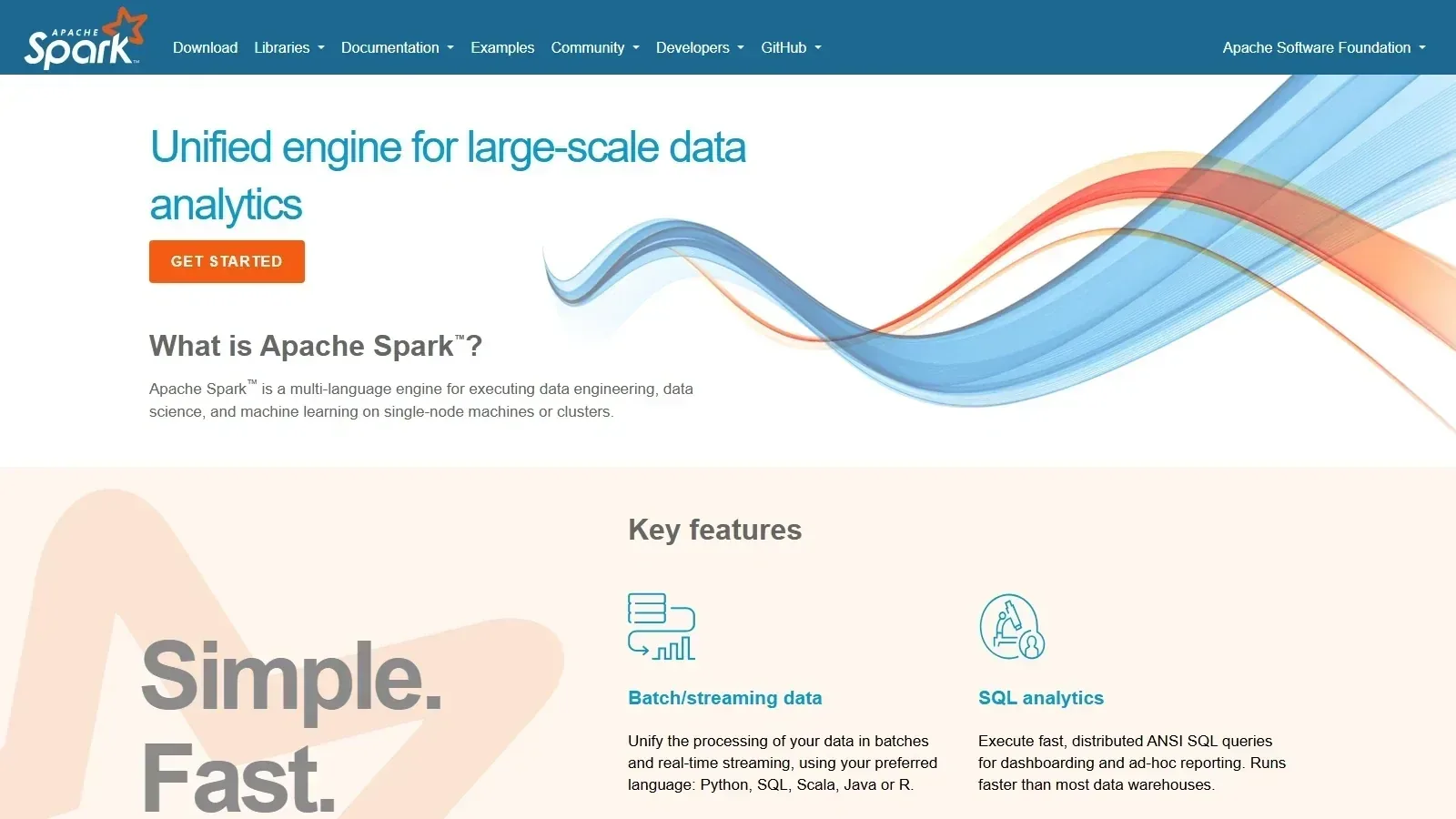 Apache Spark homepage screenshot
Alternatives
Tools to consider next

Cloudera SF 8.4
Why consider it
Hybrid data platform for enterprise AI

Starburst SF 8.5
Why consider it
Federated analytics for AI-ready data

Qlik Talend SF 8.3
Why consider it
AI-ready data integration and quality

Denodo SF 8.4
Why consider it
Logical data management for AI analytics

Informatica SF 8.7
Why consider it
AI-powered enterprise data management platform

Metabase SF 8.5
Why consider it
Open-source BI with AI-assisted querying
FAQ