
- Designed for very large fleet predictive programs
- Reuses historian and sensor data sources
- Backed by Siemens for long term support

Senseye
Scalable predictive maintenance platform
SF8.6
SF Score editorial score across features, ease, and value, based on public reviews and product research. Learn more →
Scale predictive across thousandsasset attentionpredictive maintenance
Scale predictive across thousandsasset attention
Best for
Enterprise fleet-scale predictive maintenance
Pricing
Custom
SoftFinders Score
8.6 / 10
Overview
What is Senseye?
Senseye Predictive Maintenance is Siemens’ scalable predictive-maintenance solution for manufacturers, centered on the cloud-based Senseye Cloud Application and supplemented by implementation services and expert guidance. It uses industrial AI and existing machine data to monitor asset condition, identify degradation, forecast failure risk, and prioritize where maintenance teams should investigate or intervene.
- Predictive maintenance: Senseye Cloud automatically models machine and maintainer behavior to identify abnormal deterioration and prioritize asset risks across a plant. Its analytics can highlight developing problems, failure risk, maintenance priorities, and remaining useful life, reducing the need for engineers to continuously analyze every machine manually.
- Fleet-scale operations: Senseye is designed to work across different machine types and scale from priority assets to thousands of assets across multiple plants. It uses existing condition and operational data from legacy or modern equipment, allowing manufacturers to establish a more consistent predictive-maintenance workflow across sites without requiring a separate analytics approach for every equipment vendor.
- Data and connectivity: Typical machine inputs include vibration, current, torque, temperature, and contextual operating data. Senseye can obtain information from historians, IoT platforms, databases, existing sensors, or its own cloud data store; supported ingestion methods include REST APIs, MQTT, email, AWS S3, Azure Blob Storage, and direct historian connections. New sensors are optional rather than a prerequisite when suitable machine data already exists.
- Implementation and commercial fit: Senseye Predictive Maintenance can combine the cloud application with Siemens advisory, implementation, onboarding, and optimization support. Access is subscription-based, while Siemens documentation states that onboarding into a customer's IT/OT environment can be provided for additional fees under separately agreed terms. Buyers should therefore assess asset scope, existing data infrastructure, connectivity, maintenance maturity, and planned expansion across sites.
Senseye is most relevant to manufacturers that already collect useful condition or operational data and want to scale predictive maintenance beyond isolated machines or pilot projects. Its value depends on data quality, asset criticality, maintenance adoption, and whether earlier identification and prioritization of developing failures can materially reduce unplanned downtime and improve maintenance decisions.
KEY FEATURES
What you get out of the box
Attention Index
Scores prioritize assets needing maintenance focus
Time to Failure
Forecasts remaining useful life on machines
Auto Diagnostics
Models train automatically on incoming data
Data Connectors
Reads historians sensors and operational sources
Fleet Scaling
Designed for thousands of machines together
Reliability Workflow
Routes findings into maintenance and engineering teams
USE CASES
Where teams put it to work
Scale predictive across thousands
Prioritize reliability engineer focus
Forecast time to failure
Reuse existing data sources
Standardize multi-plant predictive program
Support Siemens digital initiatives
Editorial Take
What we like, and what to verify
- Best value at fleet rather than small scale
- Needs solid historian and asset metadata quality
- Roadmap now closely tied to Siemens portfolio
Screenshots
A look inside
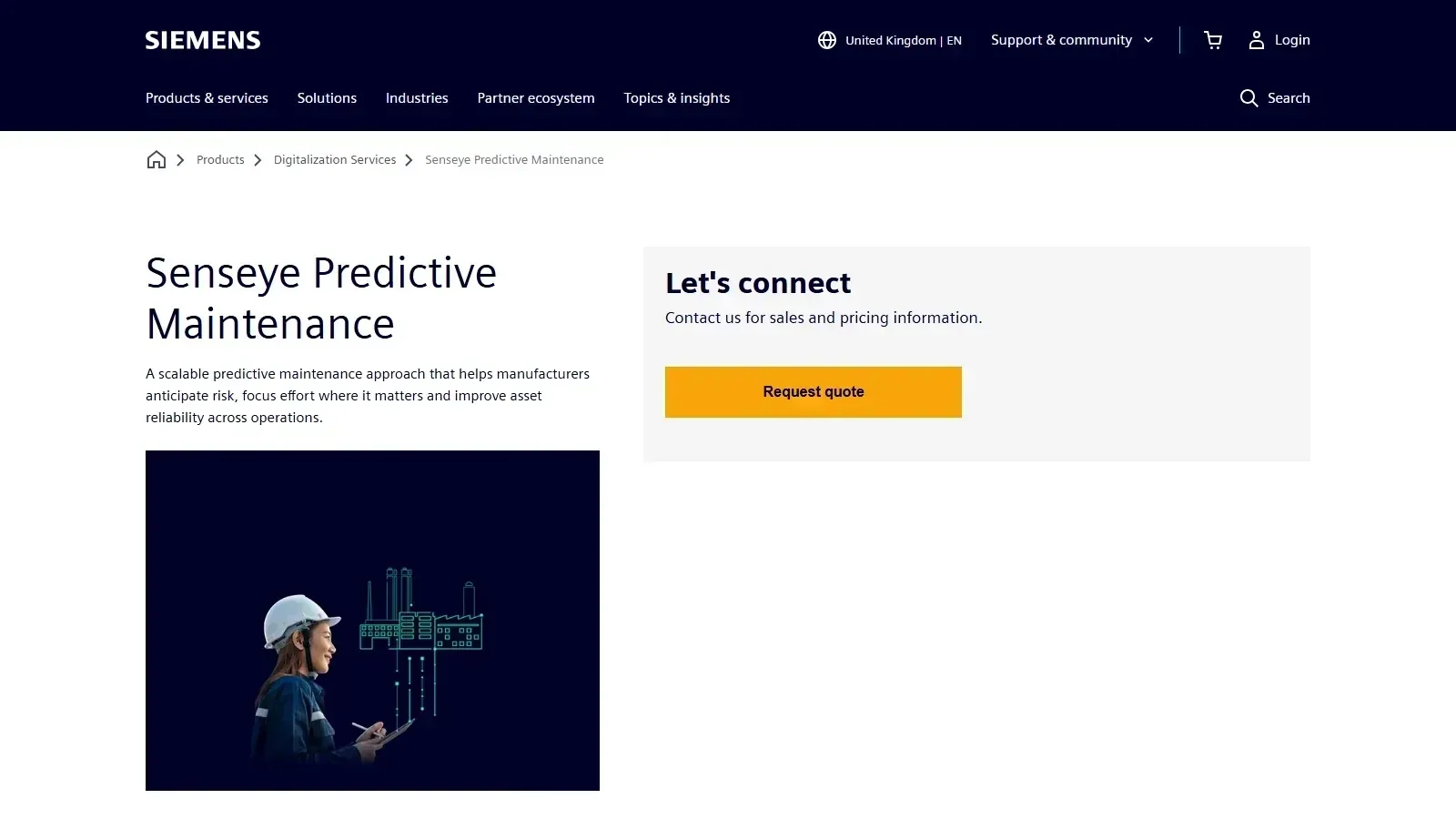 Senseye homepage screenshot
Alternatives
Tools to consider next

Infinite Uptime SF 7.9
Why consider it
Predictive maintenance for industrial machines

Predictronics SF 7.8
Why consider it
Predictive analytics for industrial assets

Augury SF 9
Why consider it
AI-driven machine health diagnostics

Petasense SF 8.1
Why consider it
Wireless sensors for machine health

Nanoprecise SF 8
Why consider it
Automated AI predictive maintenance
FAQ