
- Broad ML lifecycle coverage inside AWS environments
- Scales well for serious production workloads globally
- Deep AWS integration supports enterprise governance programs

Amazon SageMaker
Managed AI development for AWS teams
SF8.8
SF Score editorial score across features, ease, and value, based on public reviews and product research. Learn more →
Train production machine learning modelsmodel deploymentMLOps
Train production machine learning modelsmodel deployment
Best for
AWS teams scaling production AI models
Pricing
Paid
Free plan
Not available
SoftFinders Score
8.8 / 10
Overview
What is Amazon SageMaker?
Amazon SageMaker AI is the AWS machine learning service that was called Amazon SageMaker before AWS introduced a broader SageMaker platform in late 2024. It provides managed infrastructure for developing, training, fine-tuning, and deploying machine learning and foundation models. Teams can work in SageMaker Studio, run managed training jobs, use HyperPod for large distributed model workloads, orchestrate development with SageMaker Pipelines, and manage model versions and approval stages through Model Registry. For production serving, SageMaker AI supports four distinct inference patterns: real-time endpoints, asynchronous inference, serverless inference, and Batch Transform for offline predictions.
- Best fit: Data science and ML engineering teams already working heavily in AWS that need managed training infrastructure plus a route from experimentation to governed production deployment. Model Registry can connect approval stages to CI/CD deployment, while HyperPod targets longer, compute-intensive distributed training and foundation-model workloads.
- Check first: Do not confuse SageMaker AI with the newer Amazon SageMaker platform. The broader platform adds Unified Studio, Lakehouse, data and AI governance, SQL analytics, data processing, and Amazon Bedrock for generative AI applications. SageMaker AI itself uses pay-as-you-go pricing across resources such as training, hosting, storage, processing, and MLOps, so persistent real-time endpoints and large training jobs warrant explicit cost modeling. New buyers should also note that several older SageMaker AI capabilities—including Model Monitor, Clarify, Debugger, Ground Truth, and others—stopped accepting new customers on July 30, 2026.
Bottom line: SageMaker AI belongs on the shortlist when an AWS-based team needs managed infrastructure for training, versioning, workflow orchestration, and multiple production inference patterns rather than simply a hosted notebook or automated model builder.
KEY FEATURES
What you get out of the box
Managed Training
Run scalable training jobs on AWS
Model Endpoints
Deploy real-time and batch inference services
SageMaker Studio
Develop models in managed workspace environments
ML Pipelines
Automate training, evaluation, and deployment workflows
Feature Store
Reuse features across machine learning projects
AWS Integration
Connect S3, Redshift, Bedrock, and IAM
USE CASES
Where teams put it to work
Train production machine learning models
Deploy real-time inference endpoint services
Build recommendation and personalization systems
Monitor deployed model performance drift
Create GenAI applications with AWS
Govern enterprise model development workflows
Editorial Take
What we like, and what to verify
- Large feature surface can overwhelm newcomers quickly
- Cost control requires active AWS monitoring discipline
- IAM setup often slows early experimentation cycles
Screenshots
A look inside
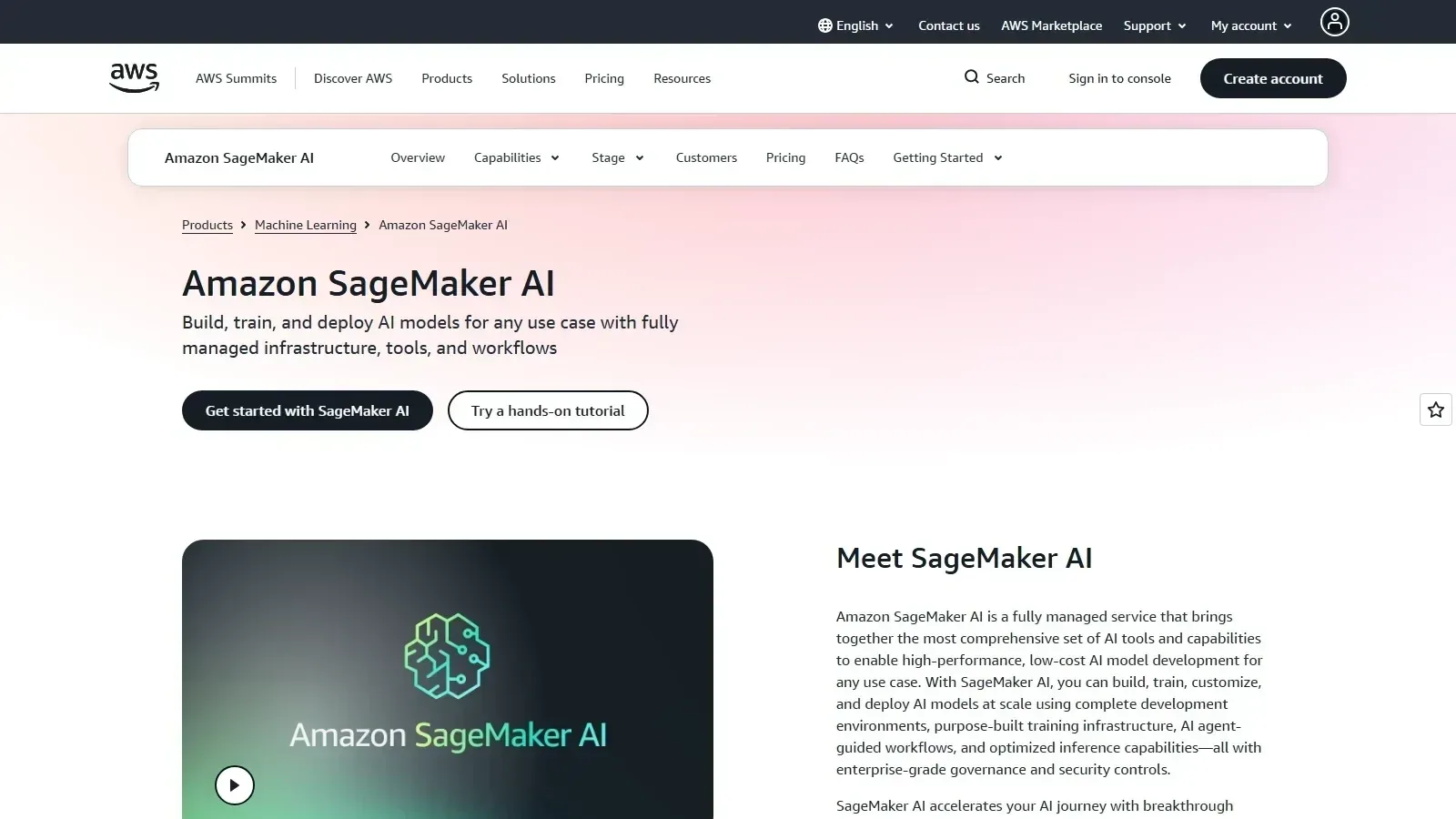 Amazon SageMaker homepage screenshot
Alternatives
Tools to consider next

Google Vertex AI SF 8.8
Why consider it
Managed ML and Gemini for GCP

DataRobot SF 8.6
Why consider it
Automated enterprise AI with model governance

H2O.ai SF 8.5
Why consider it
Open-source ML with private GenAI options

Altair AI Studio SF 8.3
Why consider it
Visual data science for analyst-led teams

KNIME SF 8.8
Why consider it
Open-source workflows for analytics and AI

Board SF 8.4
Why consider it
Integrated planning analytics for enterprise teams
FAQ