
- Broad portfolio across IoT analytics and AI
- Native fit with Azure data and analytics ecosystem
- Strong vendor backing across enterprise customers worldwide
- Supports open MQTT and OPC UA standards

Azure IoT
Microsoft cloud IoT and analytics portfolio
SF7.96
SF Score editorial score across features, ease, and value, based on public reviews and product research. Learn more →
Connect industrial devices to cloudindustrial iotiot hub
Connect industrial devices to cloudindustrial iot
Best for
Azure customers building IoT and analytics
Pricing
Custom
Free plan
Check vendor
SoftFinders Score
7.96 / 10
Overview
What is Azure IoT?
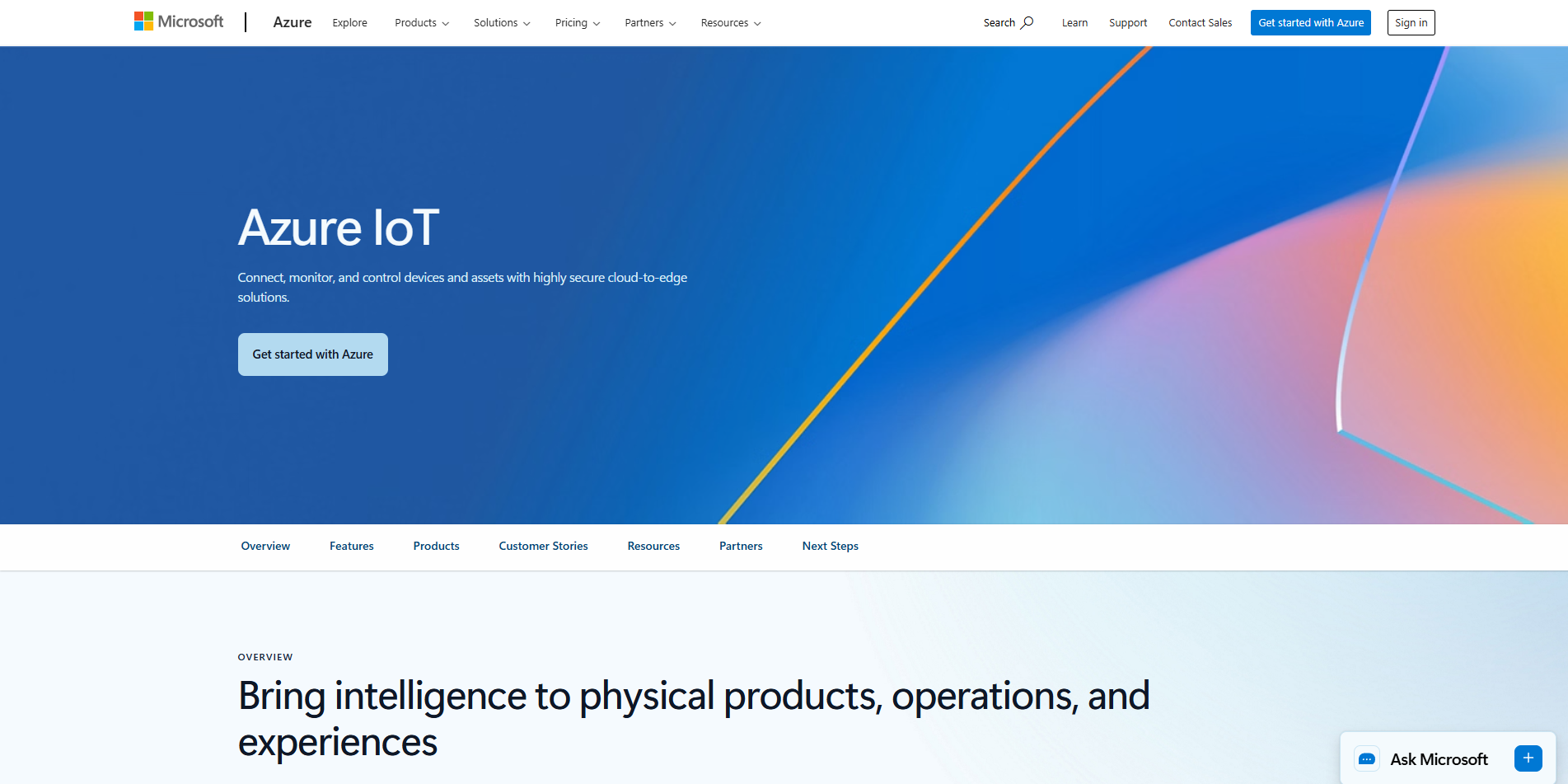
Azure IoT is Microsoft’s portfolio of cloud and edge services for connecting, managing, modeling, and analyzing IoT devices and industrial assets. Rather than being a single product, it combines services such as Azure IoT Hub, Azure IoT Operations, Azure Device Registry, Azure Digital Twins, and downstream Azure or Microsoft Fabric analytics.
- Connectivity role: Azure IoT Hub provides device-to-cloud telemetry and, on its Standard and Free tiers, cloud-to-device messaging, device twins, and device-management capabilities. Azure IoT Operations runs on Azure Arc-enabled Kubernetes at industrial sites, using an edge-native MQTT broker, OPC UA connectivity, and data flows to process, contextualize, and route operational data locally or to cloud services such as Microsoft Fabric.
- Asset management: Azure Device Registry represents devices and industrial assets as Azure Resource Manager resources so they can be governed with Azure tools, policies, tags, and RBAC. It is generally available with Azure IoT Operations; integration with Azure IoT Hub remains in preview. Azure Digital Twins separately models live relationships between physical environments, business systems, and connected-device data as a graph.
- Implementation checks: buyers should assess cloud-versus-edge connectivity patterns, industrial protocols, Kubernetes and Azure Arc requirements, device provisioning, update processes, telemetry volumes, security policies, data residency, offline requirements, and integration with services such as Event Hubs, Data Lake Storage, Azure Data Explorer, or Microsoft Fabric.
- Commercial considerations: pricing varies by service. IoT Hub is priced by selected tier, hub units, and message capacity, while Azure IoT Operations uses pay-as-you-go billing based on participating Kubernetes nodes. Azure Device Registry is billed according to registered assets and devices, with device billing having taken effect on May 1, 2026. Other services such as Azure Digital Twins have their own usage-based meters.
Azure IoT is particularly relevant to organizations that want a Microsoft-based architecture spanning cloud-connected devices, industrial edge workloads, governed asset management, digital models, and downstream analytics or AI rather than a single packaged IoT application.
KEY FEATURES
What you get out of the box
IoT Hub
Manages devices and messages at scale
Digital Twins
Models real world assets and relationships
IoT Operations
Edge platform for industrial OT data
Azure Integration
Connects with the wider Azure ecosystem
USE CASES
Where teams put it to work
Connect industrial devices to cloud
Build digital twins of operations
Run edge platforms with operations
Combine IoT with Azure analytics
Support manufacturing digital transformation programs
Standardize across many plant sites
Editorial Take
What we like, and what to verify
- Broad portfolio rather than packaged predictive product
- Needs partner support for many smaller plants
- Pricing depends on consumption across many services
- Azure IoT is a multi-service portfolio
- Usage-based pricing varies by service
Screenshots
A look inside
Alternatives
Tools to consider next

Bosch IoT Suite SF 7.25
Why consider it
Bosch IoT services and digital twin tools
AWS IoT SiteWise SF 7.92
Why consider it
AWS managed industrial IoT data service

ThingWorx Asset Advisor SF 8
Why consider it
PTC asset monitoring on ThingWorx platform

Siemens Insights Hub SF 8.1
Why consider it
Siemens industrial IoT and analytics platform

FactoryTalk Analytics SF 8.05
Why consider it
Rockwell production and asset analytics suite
USER REVIEWS
Azure IoT Reviews
Published user reviews are moderated and kept separate from the SoftFinders Score.
No published reviews yet.
Reviews from real users will appear here once published.
Used Azure IoT?
Share your experience with other buyers.
FAQ