
- Handles high call volume without constant staffing
- Natural conversations fit enterprise hotel phone needs
- Escalation paths keep complex callers supported properly

PolyAI
Voice agents for hotel phone calls
SF8.2
SF Score editorial score across features, ease, and value, based on public reviews and product research. Learn more →
Answer Hotel Calls After Hourshotel voice AIcall center
Answer Hotel Calls After Hourshotel voice AI
Best for
Enterprise hotels automating phone demand
Pricing
Custom
SoftFinders Score
8.2 / 10
Overview
What is PolyAI?
PolyAI is an enterprise conversational AI platform for building and operating voice and chat agents that can resolve customer-service interactions rather than only answer questions. Typical use cases include bookings and reservations, account management, authentication, payments, order management, troubleshooting, call routing, and escalation to human agents.
- Conversation technology: Raven is PolyAI’s default proprietary conversational model, with Raven 3.5 currently powering roughly 90% of Agent Studio implementations. In July 2026, PolyAI introduced Dialog-RSN-1, an audio-native model that jointly handles turn-taking, speech recognition, function calling, and response generation while directly processing the caller’s audio. Dialog-RSN-1 is currently recommended for English voice agents; existing customers can enable it, while new customers must request early access.
- Enterprise workflows and integrations: PolyAI agents can retrieve customer records, create and update tickets, manage reservations, access knowledge, execute backend functions, and transfer conversations with context to live staff. The platform currently advertises 130+ integrations, including Salesforce, Zendesk, Genesys, Five9, NICE CXone, Amazon Connect, OpenTable, Epic, and other industry-specific systems. Custom HTTP APIs and external MCP servers can also be connected when a native integration is unavailable.
- Build and deployment options: non-technical teams can build visually through Poly Agent Builder/Agent Studio, while developers can use the Agent Development Kit (ADK), a Python package and CLI designed for Git and CI/CD workflows. PolyAI also exposes REST APIs for programmatic agent management. Its Builder MCP wraps those APIs so MCP-compatible coding environments can create, configure, test, version, deploy, and manage PolyAI agents from an external development environment.
- Commercial considerations: production voice-agent usage is priced per minute rather than through published self-service subscription tiers. PolyAI states that ongoing usage includes maintenance, proactive performance improvements, monitoring, platform upgrades, 24/7 support, and a 99.9% uptime SLA for phone lines. Exact per-minute rates are provided through its sales process rather than publicly listed.
PolyAI is most relevant to enterprises with substantial contact-center volume and complex integrations that need conversational agents capable of completing transactions, calling backend systems, and handing unresolved interactions to human agents within an existing CX stack.
KEY FEATURES
What you get out of the box
Natural Voice
Answers hotel calls with human-like conversation
Reservation Calls
Handles booking questions before staff escalation
Guest Requests
Collects service needs and triggers staff follow-up
Brand Training
Uses property knowledge and approved responses
Call Escalation
Transfers complex calls to live agents
Reporting Tools
Tracks call patterns and unresolved topics
USE CASES
Where teams put it to work
Answer Hotel Calls After Hours
Route Guest Service Requests Faster
Reduce Missed Reservation Phone Leads
Support Multi Property Call Operations
Escalate Complex Calls To Agents
Monitor Common Hotel Caller Questions
Editorial Take
What we like, and what to verify
- Enterprise setup may feel heavy for smaller hotels
- Pricing usually requires direct sales conversations with vendor
- Performance depends on accurate property knowledge content
Screenshots
A look inside
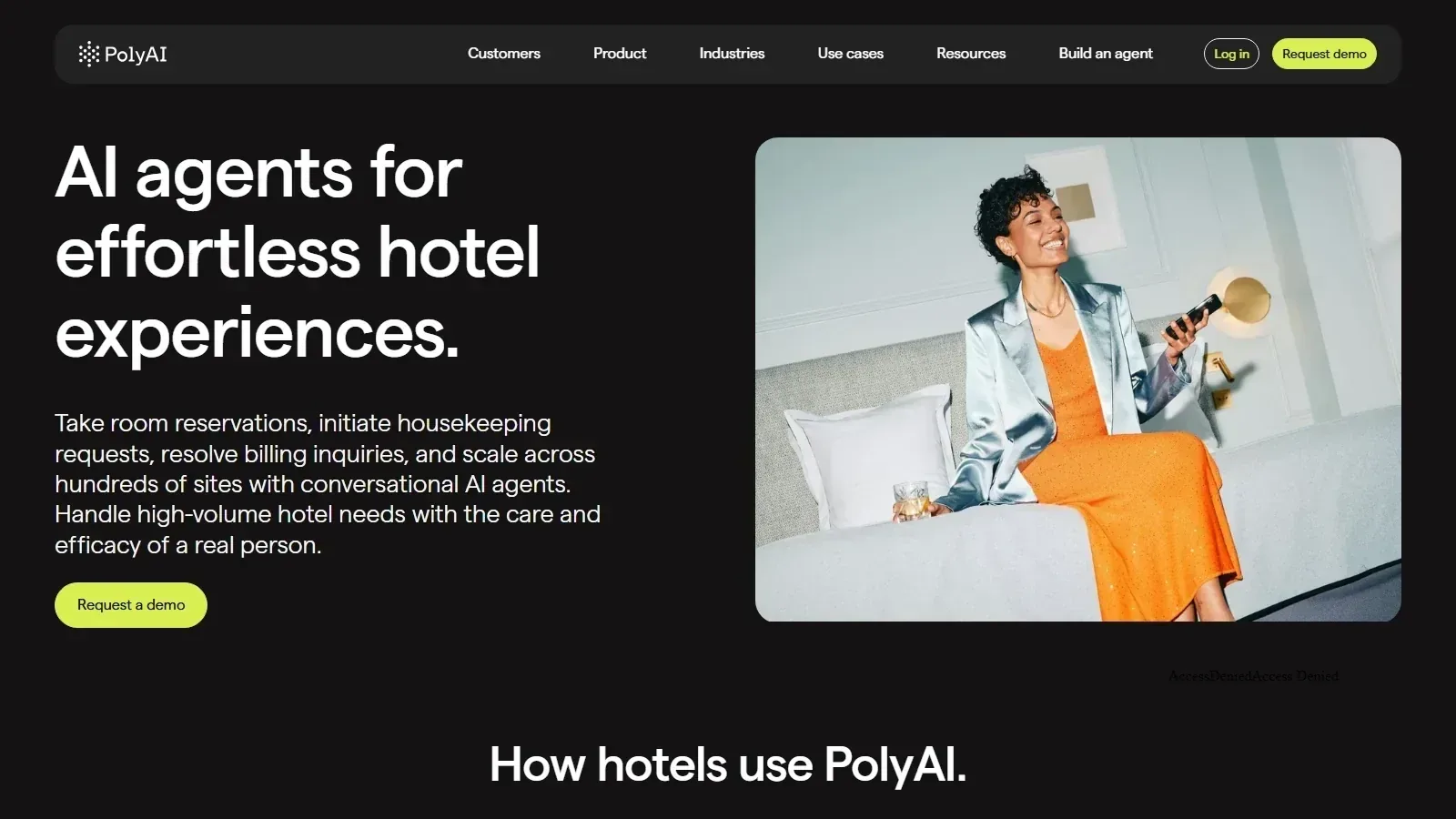 PolyAI homepage screenshot
Alternatives
Tools to consider next

Angie Hospitality SF 7.7
Why consider it
In-room assistant for hotel guest requests

MeetingPackage SF 8.4
Why consider it
Online booking for meetings and events

Event Temple SF 8.5
Why consider it
Hotel sales and catering workflow platform

Tripleseat Hotels SF 8.6
Why consider it
Event management software for hotel teams

Volara SF 8
Why consider it
Voice-first engagement for hotel rooms

Josh.ai Hospitality SF 7.6
Why consider it
Voice control for smart hotel rooms
FAQ