


Abridge
Generative AI scribe for health systems
SF Score
SF Score editorial score across features, ease, and value. Learn more →
CATEGORY GUIDE
Compare AI tools for AI Medical Scribe & Ambient Clinical Documentation Software, AI Radiology & Medical Imaging Software, AI Pathology & Digital Histology Software, AI Drug Discovery & Molecule Design Software, AI Clinical Decision Support & Medical Reference Software, and AI Symptom Checker & Patient Triage Software.
EDITOR'S PICKS
Hand-picked for category fit, not popularity
Generative AI scribe for health systems
SF Score editorial score across features, ease, and value. Learn more →

AI radiology triage across modalities
SF Score editorial score across features, ease, and value. Learn more →

Stroke and cardiovascular AI care coordination
SF Score editorial score across features, ease, and value. Learn more →

Microsoft and Nuance enterprise ambient scribe
SF Score editorial score across features, ease, and value. Learn more →
Showing 1-20 of 163 tools, plus the 4 editor’s picks above

Explore Human Anatomy in Interactive 3D

Your pharmacy. Connected

da Vinci robotic surgery with AI insights

Digital pathology AI for labs and biopharma
Specialty-focused ambient scribe with coding hints

DeepMind spinout for AI drug design

AI for OR, infusion, and inpatient capacity

Ambient AI scribe for independent clinicians

Voice-driven AI scribe and EHR assistant

FFR-CT cardiac imaging from CT scans

Patient engagement and access automation

Autonomous medical coding for hospitals

AI pathology for cancer detection

AI for radiology reporting and impressions

Precision medicine platform across data and AI

AI clinical reasoning and scribe for clinicians

ML drug discovery with proprietary biology data

AI cancer detection in radiology and oncology

EHR-integrated scheduling for medical and dental

Digital pathology image management platform
Buyer’s guide
AI healthcare software helps operational and clinical teams cut down on tedious documentation, analyze medical data, automate administrative tasks, prioritize cases and aid in decision-making. The choice of product will depend on the clinical problem, the evidence underlying the AI, the ease of integration into the existing workflow, the product's regulatory status, the controls over patient data, and the persons reviewing the product's output.
Quick answer
AI Clinical documentation software is software programs designed with the help of AI to generate clinical documentation, clinical imaging, coding, support for diagnosis, workflow automation, patient communication or medical data.
Best for
Streamlining healthcare workflows and systems in hospitals, clinics, medical practices, diagnostic services, healthcare networks, and life-sciences teams that have structured workflows optimized for continual improvement
Watch out for
Lack of clinical validation, weak integration, hallucinated data, over-alerting, uncertainty of regulatory boundaries, and data that is processed in a way that is not agreed upon by the organization.
Top-rated pick
From ambient scribes and medical coding software to radiology, pathology, patient triage, and clinical decision support, modern AI medical software exists in a variety of forms. The best healthcare AI tools address a specific issue within an existing process, not the automation of medicine in general.
Determine the products to be tested in actual clinical settings with the shortlisted representative users. Search for accuracy, lack of information, false alarms, integration with EHR or visualization system, and easyclinician challenge and correction of results.
Among the other examples of AI use identified by Software Advice are documentation, clinical decision support, patient communication, administrative support, and medical data analysis, with the reminder that software and AI results should always be supervised in terms of clinical outcomes.
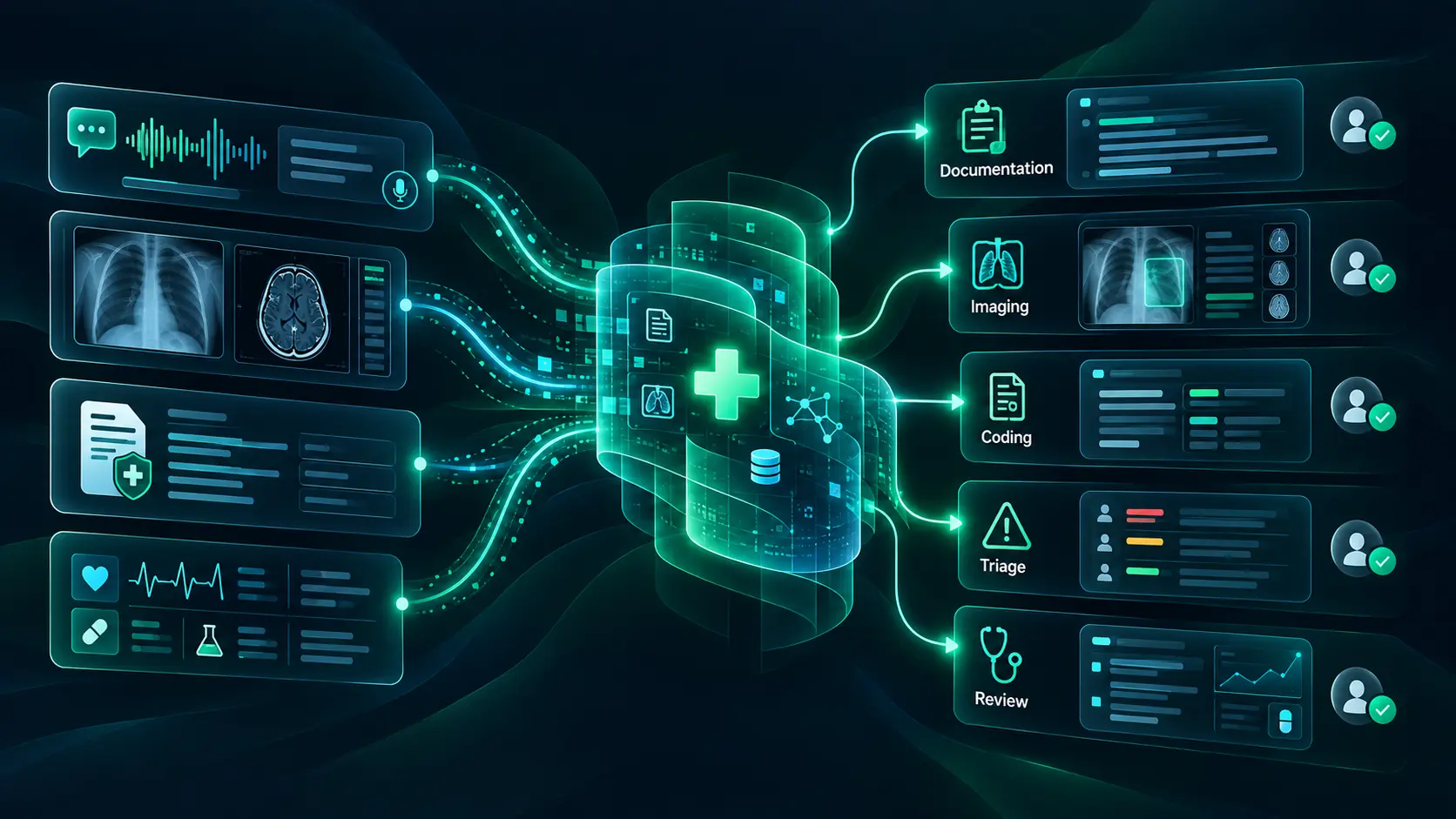
AI healthcare platforms utilize different technologies, such as machine learning, natural language processing, computer vision, and generative AI, to aid healthcare procedures.
There is a wide market. AI medical scribe software helps to transcribe consultations into draft notes. AI radiology software can highlight or prioritize imaging results. Other clinical AI programs are for coding, pathology, drug discovery, patient access or medical reference.
The best AI healthcare software should thus be evaluated based on a specific task, rather than on all AI-labeled software products. Currently, SoftFinders distinguishes the market into more than 20 healthcare subcategories and more than 160 tools.
Eliminate unnecessary re-documentation, searching or coding, or redundant data entry.
Equip teams with the most relevant information required to focus oncritical cases as a priority.
Get large quantities of clinical data and break them down into smaller systems for trained people to observe.
The factors that actually separate one tool from another — expand any for detail.

The bottom line
Choose AI software for healthcare that solves a specific problem, fits into the clinical workflow, and is easy to explain to skilled users. Try it out before implementation.
Free expert help
Still weighing your options?
Tell us what you’re trying to do and we’ll point you to the right tools — from a real advisor, not a bot.
Get a free, tailored shortlist for your team, stack and budget.
Get adviceOne reply within a business day · never shared
Editorial guidance drawn from public reviews, product data and category fit — a starting point, not a substitute for your own evaluation. How we score →